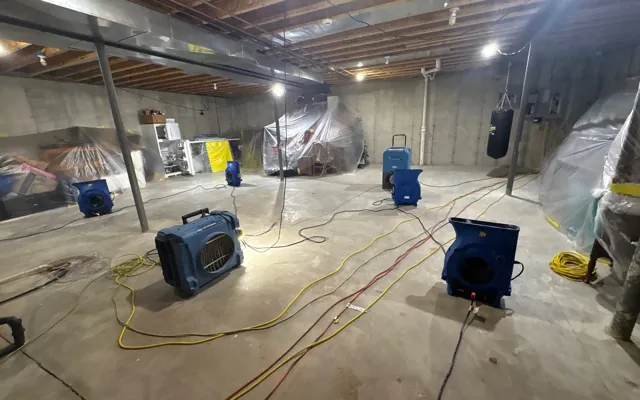
Finished basements flood fast when stone foundations seep, sump pumps fail, or a Midwest downpour outruns the drains. St. Louis crews respond 24/7 with the pumps and dehumidifiers it takes to get ahead of it.

Truck-mounted and portable pumps pull standing water out fast while initial moisture readings are taken to map how far it traveled.
Industrial dehumidifiers and air movers target the walls, subfloor, and joists, with moisture levels tracked daily until the space reads dry.
Saturated drywall, insulation, and flooring that cannot be dried in place are removed, and structural elements are cleaned and treated.
Framing, subfloor, drywall, flooring, and paint go back in once the space is confirmed dry, and sump pump repair or replacement is coordinated as part of the job.

While help is on the way, these first steps, done only where it is safe, limit the damage and protect the insurance claim.
Shut the supply off at the source, or close the home's main valve if the source is not obvious. Stopping the flow limits the damage more than anything else.
Switch off electricity to the affected area, but only if the breaker can be reached without standing in or touching the water.
Get a crew dispatched right away. The sooner extraction and drying begin, the more flooring, drywall, and belongings can be saved.
Take photos and a short video of the water and the affected rooms before anything is moved, so the insurance claim starts strong.
Basement flood cleanup in St. Louis typically runs $2,500 to $8,000, depending on how much water came in, how long it sat before being pulled out, the size of the finished basement, and how much structural material has to be replaced. Sump pump replacement, when it is needed, adds roughly $1,200 to $2,500 on top of that. Most homeowners insurance policies cover water damage from a sudden sump pump failure, burst pipe, or storm surge, and moisture readings and photo documentation are typically prepared for direct submission to the adjuster.
Crews reach St. Louis city, St. Louis County, and the Metro East fast, from Soulard and Benton Park to Clayton, University City, Kirkwood, and Florissant. See the full list on the areas served across St. Louis page.
See all areas servedEvery loss is photographed, measured, and logged from the first visit, so the paperwork holds up with your insurance carrier.
Technicians follow recognized IICRC drying standards and prove the work with daily moisture readings, not guesswork.
Emergency dispatch any hour of the day or night, with a real crew on the way, not a callback in the morning.
A real crew dispatched any hour, not a callback in the morning.
Trained technicians following recognized IICRC drying standards.
Truck-mounted, portable, and submersible for any size loss.
The loss is documented and billed to the carrier directly.
Most St. Louis basements dry within five to ten days once the standing water is out, since walls, joists, and subfloor hold moisture that has to evaporate slowly. Moisture meters track the process, and dehumidifiers and fans run around the clock until readings come back to a safe range.
Mold can start within 24 to 48 hours if moisture is left behind, which is why fast extraction and continuous drying matter more than almost anything else in the process. If any mold does appear, affected surfaces are treated and air circulation is kept up to prevent it from coming back.
Yes. Even without carpet or drywall to ruin, an unfinished basement can build up dangerous moisture, attract mold, and slowly weaken the foundation. A working sump pump with battery backup protects the framing above and keeps water from pushing into a crawl space.
Standard policies typically cover sudden events like a burst pipe, sump pump failure, or storm surge, though flooding tied to poor drainage or a neglected gutter system is usually excluded. Documentation prepared during the cleanup is what supports the claim either way.
Keeping gutters clear, running downspouts at least six feet from the foundation, having the sump pump inspected annually with a working battery backup, and sealing visible foundation cracks all cut the risk. Grading that slopes away from the house also keeps surface water from pooling against old stone foundation walls.
St. Louis crews are on call 24 hours a day, local and fast, and can be on the way within the hour.
Call (314) 762-6284