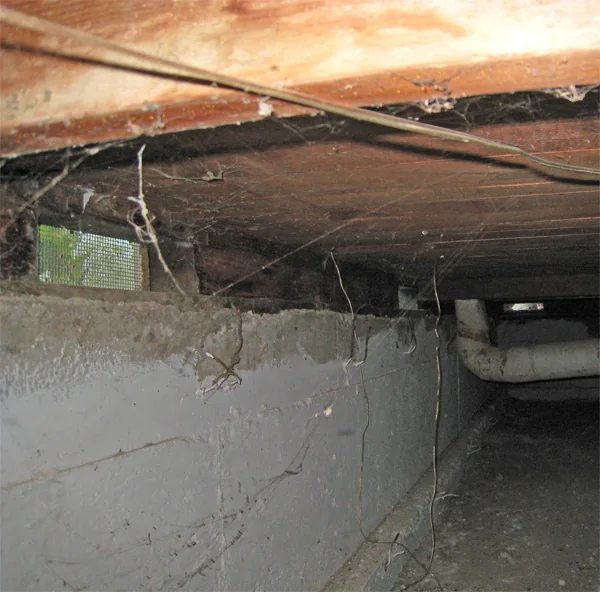
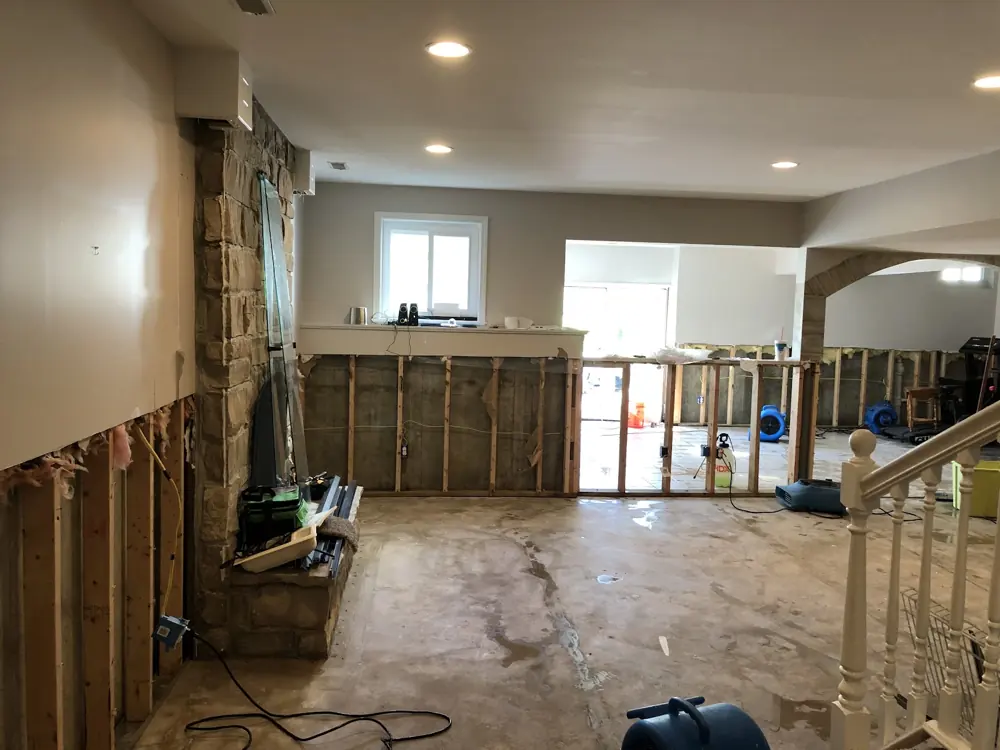
A wet crawlspace quietly rots support posts and joists long before anyone notices from upstairs. Crews extract the water, dry the space out, and put a vapor barrier down to keep it from happening again.

The crawlspace gets assessed for standing water and moisture sources, then submersible pumps clear out anything that has pooled.
Dehumidifiers sized for the crawlspace volume run continuously until the soil, posts, joists, and band boards give up the moisture they have absorbed.
Any mold growth found is removed and treated, and wood showing early signs of rot is evaluated and stabilized or reinforced as needed.
A vapor barrier goes down over the soil to control ground moisture long term, and humidity is monitored for several weeks after the dehumidifiers finish their initial run.

While help is on the way, these first steps, done only where it is safe, limit the damage and protect the insurance claim.
Shut the supply off at the source, or close the home's main valve if the source is not obvious. Stopping the flow limits the damage more than anything else.
Switch off electricity to the affected area, but only if the breaker can be reached without standing in or touching the water.
Get a crew dispatched right away. The sooner extraction and drying begin, the more flooring, drywall, and belongings can be saved.
Take photos and a short video of the water and the affected rooms before anything is moved, so the insurance claim starts strong.
Crawlspace water removal and encapsulation typically costs between $1,500 and $5,500, depending on the size of the crawlspace, how much water is involved, whether mold or rot has to be addressed, and whether a full vapor barrier goes in. Structural damage that needs stabilization pushes the cost higher. Homeowners insurance may cover a sudden water intrusion event, but ongoing humidity control is usually treated as maintenance unless it is tied directly to a specific covered loss.
Crews reach St. Louis city, St. Louis County, and the Metro East fast, from Soulard and Benton Park to Clayton, University City, Kirkwood, and Florissant. See the full list on the areas served across St. Louis page.
See all areas servedEvery loss is photographed, measured, and logged from the first visit, so the paperwork holds up with your insurance carrier.
Technicians follow recognized IICRC drying standards and prove the work with daily moisture readings, not guesswork.
Emergency dispatch any hour of the day or night, with a real crew on the way, not a callback in the morning.
A real crew dispatched any hour, not a callback in the morning.
Trained technicians following recognized IICRC drying standards.
Truck-mounted, portable, and submersible for any size loss.
The loss is documented and billed to the carrier directly.
Any standing water damages wood and feeds mold, and even without visible pooling, humidity above 60 percent is enough to start rot in posts and joists over time. A professional assessment is the only reliable way to know where a given crawlspace stands.
Yes. Mold growing in a crawlspace produces spores that move up through floor cavities and can affect air quality in bedrooms and living spaces above, which matters most for households dealing with allergies or respiratory sensitivity.
A vapor barrier is heavy plastic sheeting laid over the crawlspace soil to cut down on ground moisture rising into the space. A quality installation typically holds up for ten to fifteen years and is worth a yearly check for tears or shifting.
After the initial water removal and drying, some crawlspaces need dehumidification seasonally while others run it year-round, depending on the site's drainage and how the house sits on the lot. Monitoring after the first job determines which schedule fits.
Insurance generally covers sudden water intrusion from a storm event or a pipe failure, but not ongoing humidity or chronic poor drainage. Damage to wood structure caused by that sudden event is typically what gets covered under a standard policy.
St. Louis crews are on call 24 hours a day, local and fast, and can be on the way within the hour.
Call (314) 762-6284