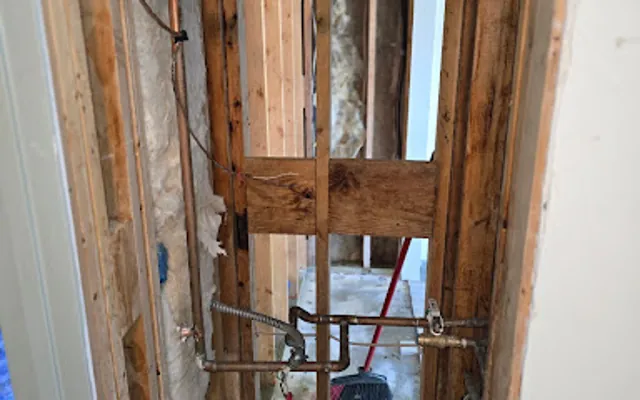
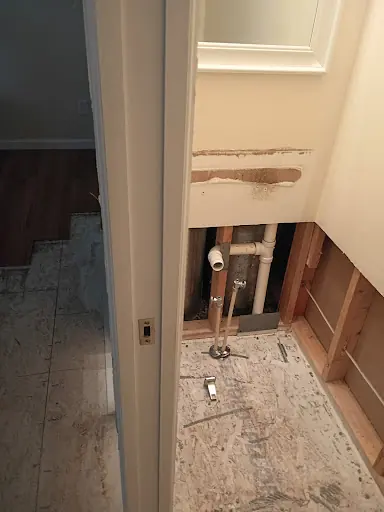
January cold snaps split water pipes sitting in exterior walls, crawlspaces, and rim joists across St. Louis. When the thaw comes, the crew is dispatched to shut off the source, pull standing water, and start drying before framing and drywall are lost.

The main valve is located and closed first, usually within the opening minutes on site, so no more water reaches the break while the rest of the property is checked for electrical hazards.
Pumps and wet vacuums pull standing water from floors and basements while the burst section of wall is opened enough to release trapped water and expose the cavity.
Thermal cameras and moisture meters trace how far water climbed inside walls and under flooring, so drying equipment gets placed by evidence rather than guesswork.
Dehumidifiers and air movers run for roughly a week to two weeks depending on how much framing and insulation took on water, with daily moisture checks until every reading is back to a dry standard.

While help is on the way, these first steps, done only where it is safe, limit the damage and protect the insurance claim.
Shut the supply off at the source, or close the home's main valve if the source is not obvious. Stopping the flow limits the damage more than anything else.
Switch off electricity to the affected area, but only if the breaker can be reached without standing in or touching the water.
Get a crew dispatched right away. The sooner extraction and drying begin, the more flooring, drywall, and belongings can be saved.
Take photos and a short video of the water and the affected rooms before anything is moved, so the insurance claim starts strong.
Frozen pipe cleanup in St. Louis typically runs from about $3,000 to $8,000, with the range driven by where the pipe sits, how much water got loose before the shut-off, and how much wall or framing has to come out. A break in an accessible spot with a fast shut-off sits on the low end; a multi-hour release inside an exterior wall that saturates framing sits on the high end. Sudden pipe freezes are commonly covered under standard homeowners policies, and photos taken as soon as it is safe help the claim move faster.
Crews reach St. Louis city, St. Louis County, and the Metro East fast, from Soulard and Benton Park to Clayton, University City, Kirkwood, and Florissant. See the full list on the areas served across St. Louis page.
See all areas servedEvery loss is photographed, measured, and logged from the first visit, so the paperwork holds up with your insurance carrier.
Technicians follow recognized IICRC drying standards and prove the work with daily moisture readings, not guesswork.
Emergency dispatch any hour of the day or night, with a real crew on the way, not a callback in the morning.
A real crew dispatched any hour, not a callback in the morning.
Trained technicians following recognized IICRC drying standards.
Truck-mounted, portable, and submersible for any size loss.
The loss is documented and billed to the carrier directly.
Slow flow from an upstairs or exterior-wall fixture, frost on an exposed pipe, or a gurgle when a faucet is opened are early warning signs during a hard freeze. Shutting off water to that fixture and calling a plumber before it bursts avoids a much bigger loss.
Insulating exposed lines, opening cabinet doors under sinks during a deep freeze, letting faucets drip slightly, sealing gaps in exterior walls, and disconnecting hoses before winter all reduce the risk. Insulation in rim joists and crawlspaces matters most in older St. Louis homes.
Most jobs run seven to fourteen days with dehumidifiers running continuously. A break that saturated multiple wall cavities or a rim joist run can take longer, and drying is not called complete until moisture meters confirm a dry standard throughout.
It can, since saturated framing and insulation give mold the conditions it needs within 24 to 48 hours. Fast extraction and dehumidification close that window before growth gets started.
Sudden freezing and bursting is commonly covered under standard homeowners policies. Damage tied to a home left unheated or pipes that were never insulated can be treated differently, so it is worth checking the policy language and filing quickly.
St. Louis crews are on call 24 hours a day, local and fast, and can be on the way within the hour.
Call (314) 762-6284