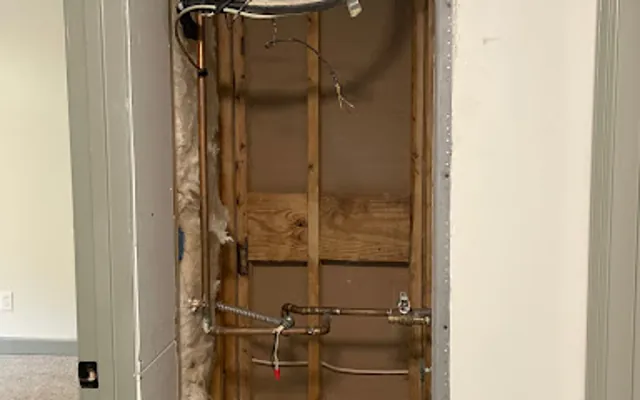
A burst pipe can run for hours before anyone finds it, soaking framing, subfloor, and drywall the whole time. St. Louis crews extract the water fast and get ahead of the structural damage before it spreads.

The burst location gets located, the supply is confirmed off, and the volume of water and the extent of the affected area are assessed before extraction starts.
Pumps and wet vacuums remove standing water from walls, floors, crawl spaces, and subfloor cavities as quickly as access allows.
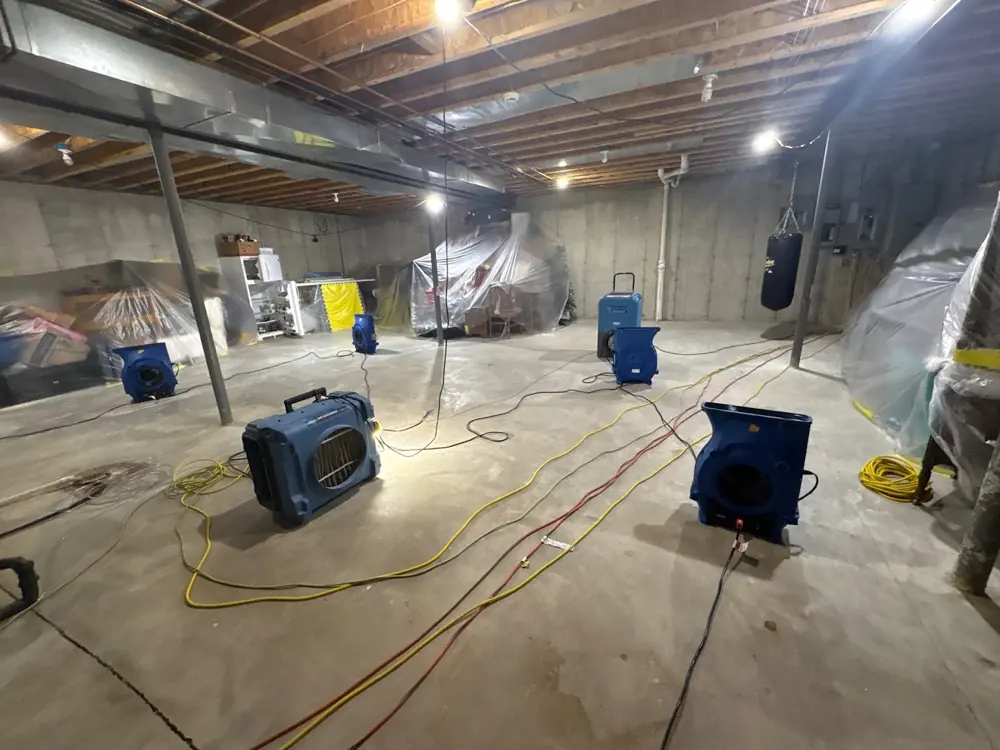
Dehumidifiers and air movers run continuously while affected wood is treated and saturated insulation that cannot be dried in place is removed.
Drywall, flooring, insulation, and paint are restored once the space reads dry, with pipe repair or replacement coordinated alongside a plumber.

While help is on the way, these first steps, done only where it is safe, limit the damage and protect the insurance claim.
Shut the supply off at the source, or close the home's main valve if the source is not obvious. Stopping the flow limits the damage more than anything else.
Switch off electricity to the affected area, but only if the breaker can be reached without standing in or touching the water.
Get a crew dispatched right away. The sooner extraction and drying begin, the more flooring, drywall, and belongings can be saved.
Take photos and a short video of the water and the affected rooms before anything is moved, so the insurance claim starts strong.
Burst pipe water damage repair in St. Louis typically runs $1,500 to $7,000, depending on how much water got out, how deep it soaked into the structure, and how much drywall, flooring, and framing needs to be replaced. A rupture inside a wall that reached the subfloor and rim band runs toward the higher end. Pipe replacement itself is a separate plumbing cost, usually $500 to $2,500, and sudden loss from a burst pipe is typically covered by homeowners insurance, with detailed mitigation documentation prepared for the claim.
Crews reach St. Louis city, St. Louis County, and the Metro East fast, from Soulard and Benton Park to Clayton, University City, Kirkwood, and Florissant. See the full list on the areas served across St. Louis page.
See all areas servedEvery loss is photographed, measured, and logged from the first visit, so the paperwork holds up with your insurance carrier.
Technicians follow recognized IICRC drying standards and prove the work with daily moisture readings, not guesswork.
Emergency dispatch any hour of the day or night, with a real crew on the way, not a callback in the morning.
A real crew dispatched any hour, not a callback in the morning.
Trained technicians following recognized IICRC drying standards.
Truck-mounted, portable, and submersible for any size loss.
The loss is documented and billed to the carrier directly.
Water stains on a wall or ceiling, drywall that has gone soft or spongy, an unexplained musty smell, or a hissing sound inside the wall are all signs worth acting on fast. Shutting off the main water valve and getting an inspection scheduled right away limits how far the damage spreads.
Getting extraction started first keeps the water from spreading and sets up the drying process, while a plumber handles the pipe repair once the immediate water is under control. The two typically work in parallel rather than one waiting on the other.
Drying usually takes five to ten days depending on how deep the water soaked and which materials absorbed it, since drywall and framing hold moisture that has to come out slowly. Daily moisture meter readings track when the space is actually dry rather than just dry to the touch.
A burst pipe is often a sign of aging supply lines throughout the house, so a home with more than one failure or with original galvanized or copper lines is worth having fully inspected. That assessment gets coordinated with a plumber alongside the water damage repair.
Sudden loss from a burst pipe is typically covered, minus the deductible, though damage tied to long-term neglect or a home left unheated through a freeze is usually excluded. Photos and moisture documentation prepared during the cleanup support the claim either way.
St. Louis crews are on call 24 hours a day, local and fast, and can be on the way within the hour.
Call (314) 762-6284