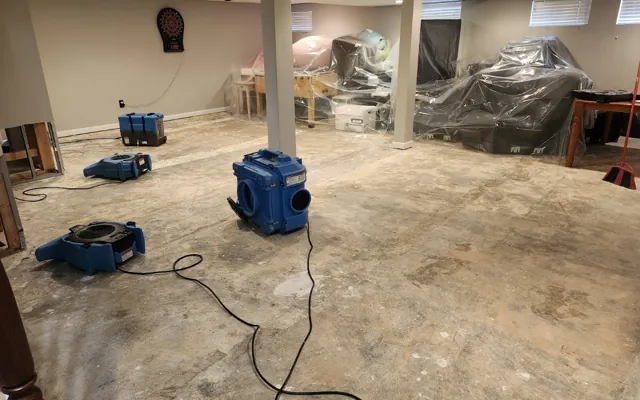
A sump pump that quits during heavy rain leaves a basement flooded within hours. Local crews extract the water and dry a finished basement within about 48 hours to keep mold from setting in.

Truck-mounted pumps and industrial extractors remove standing water from the basement in hours, not days.
Flooded drywall, carpet, and other affected material is carefully removed, with structural damage assessed and documented for the claim.
Dehumidifiers and air movers run continuously for 48 to 72 hours to dry subflooring, concrete, and wall cavities completely.
Once the space is dry and clear of mold, flooring and drywall are restored, and installation of a new pump with a battery backup is coordinated.

While help is on the way, these first steps, done only where it is safe, limit the damage and protect the insurance claim.
Shut the supply off at the source, or close the home's main valve if the source is not obvious. Stopping the flow limits the damage more than anything else.
Switch off electricity to the affected area, but only if the breaker can be reached without standing in or touching the water.
Get a crew dispatched right away. The sooner extraction and drying begin, the more flooring, drywall, and belongings can be saved.
Take photos and a short video of the water and the affected rooms before anything is moved, so the insurance claim starts strong.
Sump pump failure basement cleanup typically runs $2,000 to $7,000, depending on how much water accumulated, the flooring type, whether finished surfaces and contents were damaged, and how long drying takes. A bare concrete basement dries faster than one with carpet and finished walls. Homeowners insurance commonly covers sudden pump failure and the resulting damage to structure and belongings.
Crews reach St. Louis city, St. Louis County, and the Metro East fast, from Soulard and Benton Park to Clayton, University City, Kirkwood, and Florissant. See the full list on the areas served across St. Louis page.
See all areas servedEvery loss is photographed, measured, and logged from the first visit, so the paperwork holds up with your insurance carrier.
Technicians follow recognized IICRC drying standards and prove the work with daily moisture readings, not guesswork.
Emergency dispatch any hour of the day or night, with a real crew on the way, not a callback in the morning.
A real crew dispatched any hour, not a callback in the morning.
Trained technicians following recognized IICRC drying standards.
Truck-mounted, portable, and submersible for any size loss.
The loss is documented and billed to the carrier directly.
Most sump pumps last 7 to 10 years with regular maintenance. A pump older than 10 years, or one making a grinding sound, is worth replacing before heavy rain season hits.
Common causes include motor burnout from age, a clogged discharge line, a stuck float, and a loss of power, whether from an outage or a tripped breaker. Skipping regular maintenance speeds up failure.
Generally, yes. A battery backup runs about 300 to 800 dollars installed and can prevent thousands of dollars in basement flood damage if power fails during a storm.
It depends on groundwater pressure and rainfall intensity. During a heavy storm, a failed pump can let six to twelve inches of water accumulate in just a few hours.
Typically, yes. Sudden pump failure and the resulting water damage to a home's structure and belongings are covered under standard homeowners policies.
St. Louis crews are on call 24 hours a day, local and fast, and can be on the way within the hour.
Call (314) 762-6284